Nimblebit's Pocket Frogs +Plus http://nimblebit.com/

A little known fact about me is that I actually started out in the world of higher education as a Biology major. In fact almost all of my “elective” classes at the University of Delaware ended up being in the sciences despite the fact that I officially graduated with an English major and a Fine Arts minor. Yes, I am an eclectic one. My love of Biology was really sealed in 10th grade Bio class with Ms. Houghton when we were doing genetics experiments with Drosophila melanogaster – fruit flies. Ms. Houghton was in her first year of teaching and fresh out of grad school. She was tough but excited about bringing as much practical lab work into the classroom as possible. She was an amazing teacher. I became a whiz at breeding Drosophila. I even took mine home over spring break, much to my mother’s dismay. She wasn’t too excited about my science experiment hanging out in the kitchen, although I assured her it was completely self-contained. I became so good at breeding the little critters that at one point the University lost their entire supply and I ended up breeding a new supply to restock them. By then I was a senior and a lab aide to Ms. Houghton and had also taken AP Bio.
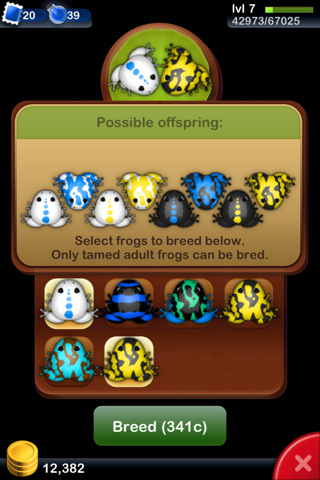
Imagine my excitement when I discovered an iPhone app where I could “virtually” breed critters! Nimblebit’s Pocket Frogs on the +Plus network is a wonderful app that has huge potential for helping teachers demonstrate basic genetics in action, hunt strategies, natural and sequential patterns, basic classification systems, scientific nomenclature through a fictional version, organization of information, and allocation of resources through creation of a small business. I’ve fiddled with the app for months and am pleased with how it is set up. It essentially allows the user to breed and collect frogs while increasing levels and gaining “money” to buy habitats and therefore collect more frogs. There are goals for collecting certain frogs. As the player becomes more savvy, they figure out how to breed specific frogs more easily. I can pretty much breed anything I want because I understand the underlying idea of genetics and simply pick out the features I want to create the specific frog. It may take a little while, but I am always able to do it.
For a student who doesn’t understand how genetics works, it would be challenging. My 8 and 10-year-old children, for example, find the game a little more challenging than I do and simply go around collecting frogs. They don’t understand how to breed specific frogs. That’s where the app is great as a teaching tool for older students – like high school bio students who are not often getting the opportunity to do genetics labs in the classroom today. An app like this provides a great opportunity to ensure that they really do understand genetics rather than just repeating what they are reading in their textbooks and has the bonus of being fun. It also provides the integration of other related skills like scientific nomenclature. The frogs all have names that relate to traits that are expressed. It is similar to traditional scientific nomenclature that would be Family-Genus-Species. They are then organized according to this nomenclature in a FroggyDex and as each frog is collected it is highlighted in the individual’s FroggyDex showing how many frogs have been collected and how many total can be collected. I have collected approximately 2200 so far. My next goal to reach is 5000. I’m almost half way there.
I see so much potential for doing so many things with this app collaboratively with Biology, Math, and Economics/Business teachers in a high school that would take the learning far deeper beyond the textbooks so that students are using what they are learning and actually putting it into action and then discussing it. I think that that is what will make all the difference and ensure that they remember what they learn long after any tests they may take. And on top of that, they may actually have a little fun!
 |
| Breeding |
 |
| Some of the varieties within one "species" |
 |
| Frogs in a pond and in a habitat |
 |
| Frogs in a habitat at level 7 -- I'm at level 23 |
 |
| Some of the beautiful and diverse array of frogs |




No comments:
Post a Comment